Artisan Bean vs Tank Coffee: A 2026 Comparison
Table of Contents
- How Artisan Bean and Tank Coffee Stack Up: The Basics
- Artisan Coffee vs Commercial Coffee: What the Labels Actually Mean
- Coffee Bean Taste Comparison: Like-for-Like Brew Test
- Coffee Roast Levels and Flavor Notes Across Both Brands
- Price Per Cup and Subscription Economics
- Best Coffee Beans for Everyday Brewing: Which Brand Wins
- Brew-Method Compatibility: Espresso, Pour-Over, French Press, and More
- Verdict: Which Brand Fits Your Firm's Coffee Needs
- Frequently Asked Questions
Last Updated: October 13, 2026
How Artisan Bean and Tank Coffee Stack Up: The Basics
An artisan bean vs tank coffee comparison comes down to one question: do you want coffee roasted in small batches for peak freshness, or coffee built for shelf stability and volume?
The specialty coffee market has grown steadily, and the Specialty Coffee Association's industry reporting tracks how small-batch roasters now compete directly with large commercial operations. The practical difference shows up in your cup, not on a label.
Here is the core trade-off:
- Artisan roasters roast to order in small batches, so beans arrive days off the roast, not months.
- Commercial brands roast at scale for consistency and shelf life, which favors volume buyers and long storage.
- Freshness is the dividing line. Whole beans start losing aroma within weeks of roasting, not months.
Most guides treat this as a taste contest. It is not. The real decision is how fast your team drinks through a bag.
Artisan Coffee vs Commercial Coffee: What the Labels Actually Mean
That labeling difference matters more than the word "premium" on the front of the bag. A roast date tells you when the clock started; a best-by date tells you almost nothing.
Commercial roasters earn consistency by blending origins and roasting darker, which masks variation between harvests. Small-batch roasters let origin character and processing method show through. Neither is dishonest; they solve different problems.
Pro Tip
Flip the bag over before you commit to a supplier. If there is no roast date, only a best-by date, you are buying shelf stability, not freshness. Ask your vendor for the roast date in writing.
Coffee Bean Taste Comparison: Like-for-Like Brew Test
A fair coffee bean taste comparison means brewing both the same way, same grind size, water temperature, and brew ratio. Change one variable and you taste your equipment, not the beans.
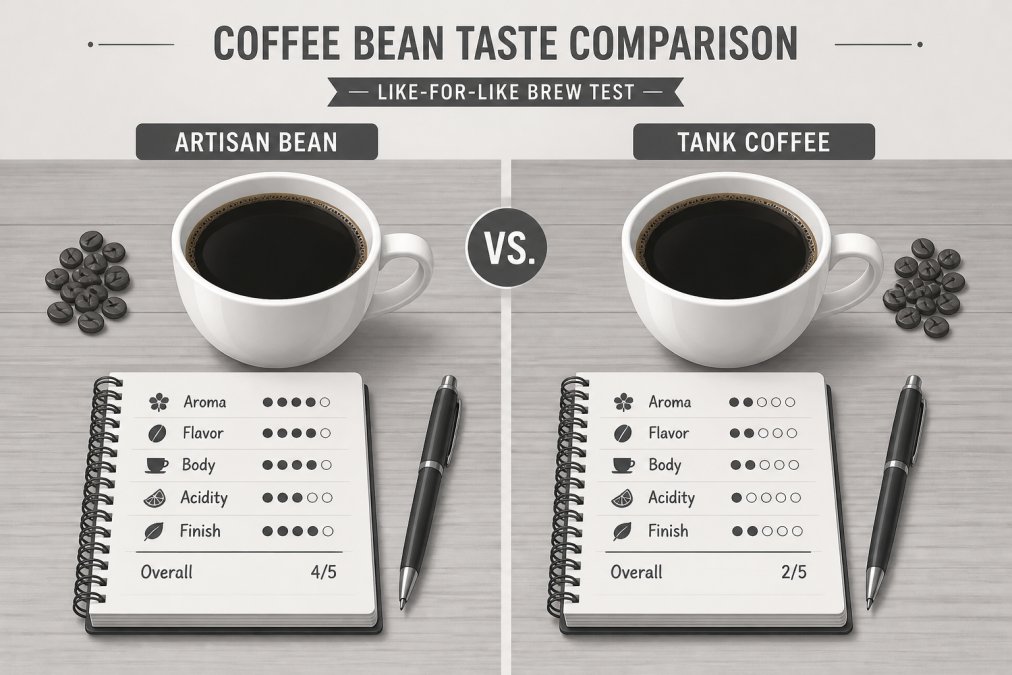
Here is how to run the test yourself:
- Weigh 15 grams of whole beans from each brand and grind them to the same setting.
- Heat water to roughly 200°F and use a 1:16 coffee-to-water ratio.
- Brew both in the same method, back to back, and taste them side by side.
- Note sweetness, acidity, mouthfeel, and finish on paper before you compare notes.
Freshly roasted beans show more sweetness and aroma; shelf-sat beans taste flatter, with muted acidity and a shorter finish. That gap is the argument for roast-to-order coffee, and it is easy to verify in your own kitchen.
Coffee Roast Levels and Flavor Notes Across Both Brands
Roast level drives flavor more than almost any other factor.
Commercial blends usually land dark-to-medium because darker roasting covers inconsistencies between harvests. Small-batch roasters often offer a full range, so you can match roast to brewing method.
| Roast Level | Flavor Notes | Acidity | Best Brewing Method |
|---|---|---|---|
| Light | Fruit, floral, bright | High | Pour-over, drip |
| Medium | Caramel, nut, balanced | Medium | Drip, French press |
| Dark | Cocoa, smoke, bold | Low | Espresso, Moka pot |
Oily beans signal a darker roast, normal for espresso but able to clog a pour-over filter. If your team brews several ways, a medium roast is the safest single bag to keep on the shelf.
Price Per Cup and Subscription Economics
Price per cup, not price per bag, should decide your break room budget. A larger bag at a higher sticker price can cost less per cup than a cheap bag your team burns through twice as fast. Here is the arithmetic.
The formula is simple:
Cost per cup = (bag price + shipping) ÷ usable cups per bag
Usable cups depends on dose. A standard drip dose is about 0.36 ounces (10 grams) per 6-ounce cup, the ratio most automatic brewers are calibrated around.
Run it both ways on a 12-ounce bag:
| Dose per cup | Cups per 12 oz bag | Cost per cup at $18 bag | Cost per cup at $12 bag |
|---|---|---|---|
| 0.36 oz (10 g) | ~33 | ~$0.55 | ~$0.36 |
| 0.53 oz (15 g) | ~23 | ~$0.78 | ~$0.52 |
| 0.75 oz (21 g) | ~16 | ~$1.13 | ~$0.75 |
Those are illustrative figures using round bag prices, not quotes from any roaster.
Now layer in the costs people forget:
- Shipping. Many small roasters include free shipping above a threshold (commonly $35 to $50). Paying $6 to ship one 12-ounce bag adds roughly $0.18 to $0.38 per cup depending on dose.
- Waste. If your team pours out the last quarter of every bag, your effective cost per cup rises by about a third, a habit that erases most bulk discounts.
- Grinder and filter consumables. Paper filters run a few cents per brew; a burr grinder is a one-time cost but a real one.
Subscriptions align delivery with actual consumption instead of a guess. Check these mechanics first:
- Cadence options. Weekly, biweekly, and monthly are common. Match the interval to real volume: a firm brewing two 60-ounce pots a day goes through roughly 1.5 to 2 pounds per week; an eight-person practice brewing one pot a day goes through about half a pound per week.
- Skip, pause, and swap terms. Confirm you can skip a shipment before a holiday week or swap a roast without penalty. A subscription you cannot pause generates waste.
- Discount structure. Many roasters apply a standing percentage off for subscribers. Ask whether the discount applies to every shipment or only the first.
- Cancellation terms. Look for month-to-month with no minimum commitment. Annual prepay lowers the per-bag price but locks you in if headcount changes.
- Roast-to-ship timing. The best subscriptions roast after you order. Ask how many days pass between roast and ship; a two-to-three-day turnaround is a common small-batch target.
To set your cadence, track how many pounds your office consumes for two weeks, then order slightly under that number.
Watch Out
The most common mistake is buying in bulk to save money, then letting the last third of every bag go stale. Stale coffee gets poured out, and that waste erases any bulk discount you thought you were getting.
Best Coffee Beans for Everyday Brewing: Which Brand Wins
The best coffee beans for everyday brewing are the ones your team will actually finish while they are still fresh. For most law offices, that means a roast-to-order supplier with a subscription cadence matched to real consumption.
Here is where Defensive Grounds fits. We roast to order in small batches and ship free anywhere in the United States, so a bag arrives days off the roast rather than months.
What sets us apart is not just the roast: we built the whole brand around the legal profession, with witty case-themed naming and packaging that reads as insider humor rather than a generic office supply.
Best For
Law firms and legal teams that want fresh, small-batch coffee with branding that speaks to the profession, from an eight-person practice to a full floor of associates.
Brew-Method Compatibility: Espresso, Pour-Over, French Press, and More
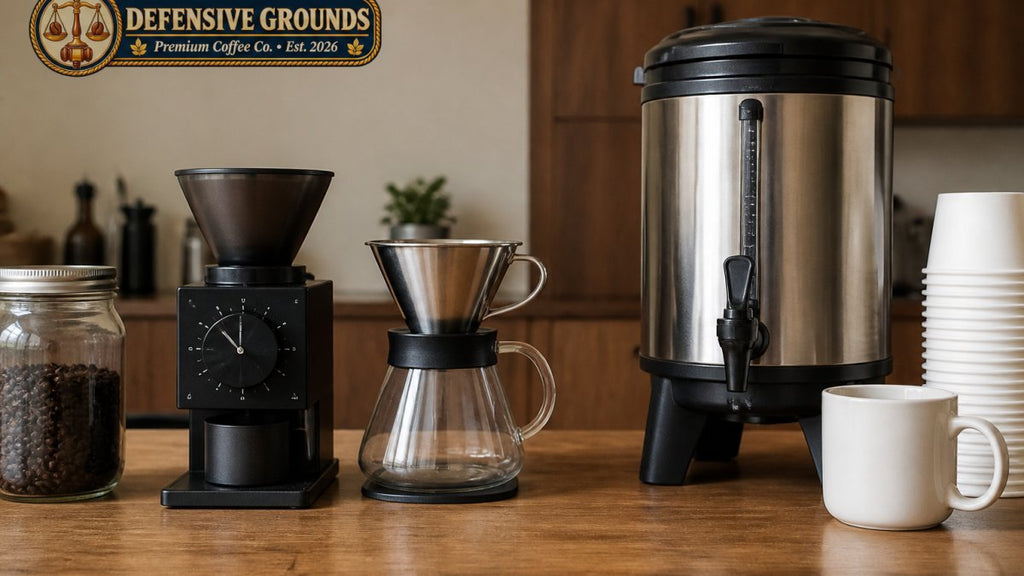
Brew-method compatibility decides whether a bag works for your whole office or just one person. The same coffee can shine in a French press and disappoint in an espresso machine, so match the roast to your equipment.
A quick compatibility guide:
- Espresso: medium to dark roasts, fine grind, high pressure. Oily beans are normal here.
- Pour-over: light to medium roasts, medium grind, and a steady pour for a clean finish.
- French press: medium to dark roasts, coarse grind, full immersion for heavy body.
- Moka pot: medium roasts, fine grind, stovetop pressure for a strong, espresso-like cup.
- Automatic brewer: medium roast, medium grind, the most forgiving setup for a busy break room.
Starting recipes, using a 1:16 coffee-to-water ratio as the baseline (about 0.36 ounces, or 10 grams, of coffee per 6 ounces of water):
| Method | Dose | Water | Grind | Water Temp | Time |
|---|---|---|---|---|---|
| Pour-over (cone) | 22 g | 350 g | Medium, like table salt | 200°F | 2:30-3:00 |
| French press | 30 g | 500 g | Coarse, like sea salt | 200°F | 4:00 steep, then press |
| Automatic drip | 60 g | 1,000 g (about 34 oz) | Medium | Brewer-controlled | Follow machine cycle |
| Moka pot | 18 g | 150 g | Fine, slightly coarser than espresso | Preheated, off boil | Until it gurgles, then cut heat |
| Espresso | 18 g | 36 g out | Fine, espresso setting | 200-205°F | 25-30 seconds |
These are starting points, not laws. Adjust one variable at a time: sour and thin means grind finer or extend time; bitter and dry means grind coarser or shorten time.
Grind size is the lever most people get wrong.
A few method-specific notes:
- Espresso and oily beans. Dark, oily beans are normal for espresso, but oil residue builds up in the grinder and portafilter. Wipe the burrs and basket weekly.
- Pour-over and light roasts. Light roasts are denser and drain slower. If your cone stalls, coarsen the grind slightly rather than pouring faster.
- French press and fines. Coarse grind plus a 4-minute steep gives full body, but fine particles slip through the mesh. Let the press sit 30 seconds after plunging before pouring.
- Moka pot and heat. High heat scorches the coffee. Start with hot water in the base, keep the flame low, and pull it off the burner the moment it sputters.
- Automatic brewer and batch size. Most brewers are calibrated for a full batch; a half batch often under-extracts because the machine runs the same cycle with less water. If your team drinks small volumes, a pour-over setup may beat a big brewer on quality.
If your firm runs a single automatic brewer, one medium roast covers almost everyone.
Key Takeaway
Match the roast to the machine, then dial in dose, grind, and time one variable at a time. A medium roast with a burr grinder covers the widest range of office brewing setups.
Verdict: Which Brand Fits Your Firm's Coffee Needs
For a law firm that values freshness, flavor, and branding that fits the profession, roast-to-order artisan coffee is the stronger choice. Commercial coffee wins on shelf life and bulk convenience, which matters if you buy once a quarter and store it in a closet.
That is the case we make at Defensive Grounds. We roast to order so your coffee arrives fresh, ship free anywhere in the United States, and wrap it in legal-themed branding that turns a break room cup into a small moment of camaraderie.
Get started with Defensive Grounds and give your team coffee that finally understands the daily grind.
Frequently Asked Questions
What is the difference between artisan coffee and commercial coffee?
Artisan coffee is roasted in small batches, often to order, with a focus on bean origin and freshness. Commercial coffee is mass-produced, typically roasted months in advance and distributed through grocery channels. The practical difference shows up in the cup: artisan beans tend to have brighter acidity, clearer flavor notes, and a roast date you can trust. Commercial bags prioritize shelf stability over peak flavor, so the taste is flatter and the aroma fades faster after opening.
Is Tank Coffee or Artisan Bean better for everyday brewing?
It depends on your setup and how you brew. Tank Coffee leans toward a consistent, medium-dark profile that works well in automatic drip machines and French press, where a bolder, less acidic cup is the goal. Artisan Bean offers more variety in single-origin and light-roast options, which suit pour-over and espresso if you want to taste distinct flavor notes. For a breakroom with a standard drip brewer, either works. For a team that experiments with grind size and brew ratios, Artisan Bean gives more room to dial in.
How should you compare coffee roast levels and flavor notes between brands?
Brew the same bean weight, use the same water temperature and brew ratio, and taste both cups black before adding anything. Note the aroma first, then acidity, sweetness, and mouthfeel. Light roasts show fruit and floral notes with higher acidity. Medium roasts balance sweetness and body. Dark roasts push smoky, chocolate, and caramel flavors with lower acidity. Comparing the same roast level across two brands is the only fair test, since a light roast from one brand will taste nothing like a dark roast from another.
Is freshly roasted coffee worth the extra cost per cup?
Freshness affects flavor more than almost any other variable. Coffee peaks roughly 4 to 14 days after roasting, then declines. Beans roasted to order and shipped within days of the roast date will taste noticeably brighter and more aromatic than bags that sat on a shelf for months. When you calculate price per cup, the gap often narrows: a 12-ounce bag at a higher upfront cost can still land within a few cents per cup of a cheaper commercial option, especially if you grind whole beans yourself.