French Press vs AeroPress Coffee: Which Brew Fits Your Desk
Last Updated: November 10, 2026
Quick Summary
French press vs AeroPress coffee comes down to body versus clarity. The French press steeps coarse grounds for 4-5 minutes and gives a heavy, full-bodied cup with sediment, while AeroPress coffee pushes water through a paper filter in 1.5-3 minutes for a smoother, cleaner cup. For a desk, the AeroPress wins on speed and cleanup.
- The French press needs a coarse, sea-salt grind, while the AeroPress takes a fine to medium-fine grind.
- A French press brews eight or more cups, but the AeroPress holds about 12 to 14 ounces.
- Both starting recipes sit near a 1:16 coffee-to-water ratio by weight.
- The AeroPress runs on paper micro-filters, a small recurring cost the French press avoids.
- Press an AeroPress slowly and keep it flat so hot coffee does not slip and spill.
Which brewer fits your desk?Defensive Grounds roasts legal-themed specialty coffee to order and ships it free nationwide.
Shop the Sample Pack
Table of Contents
- French Press vs AeroPress Coffee: The Short Answer
- French Press vs AeroPress Coffee Taste: Body, Clarity, and Sediment
- French Press vs AeroPress Grind Size and Brew Ratios
- Brew Time, Capacity, and Cleanup on a Deadline
- AeroPress vs French Press vs V60: Where Pour-Over Fits
- AeroPress vs French Press vs Drip Coffee: Office and Break Room Reality
- Cost of Ownership, Filters, and Physical Effort
- Stocking Your Break Room With the Right Beans
- Frequently Asked Questions
French Press vs AeroPress Coffee: The Short Answer
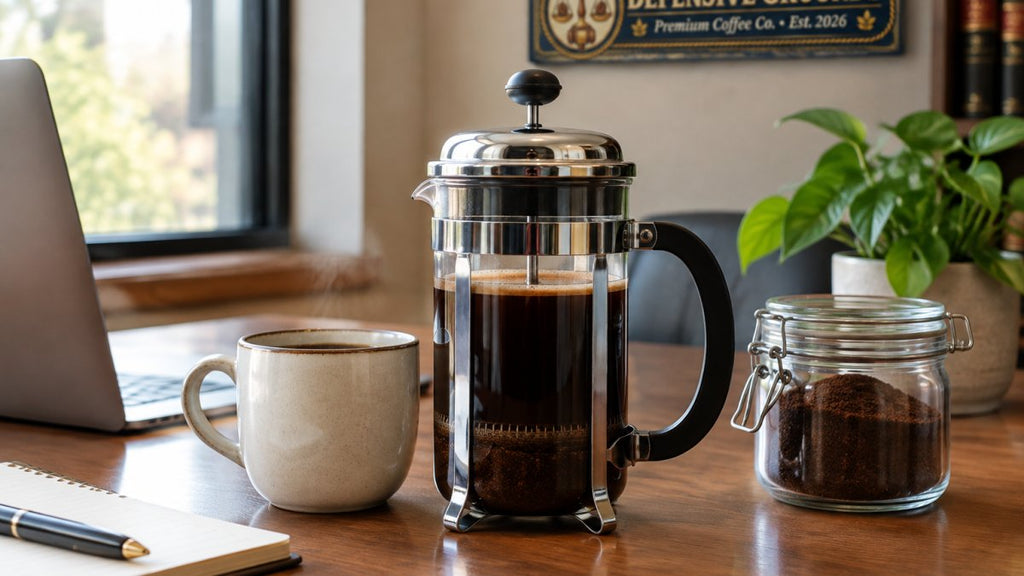
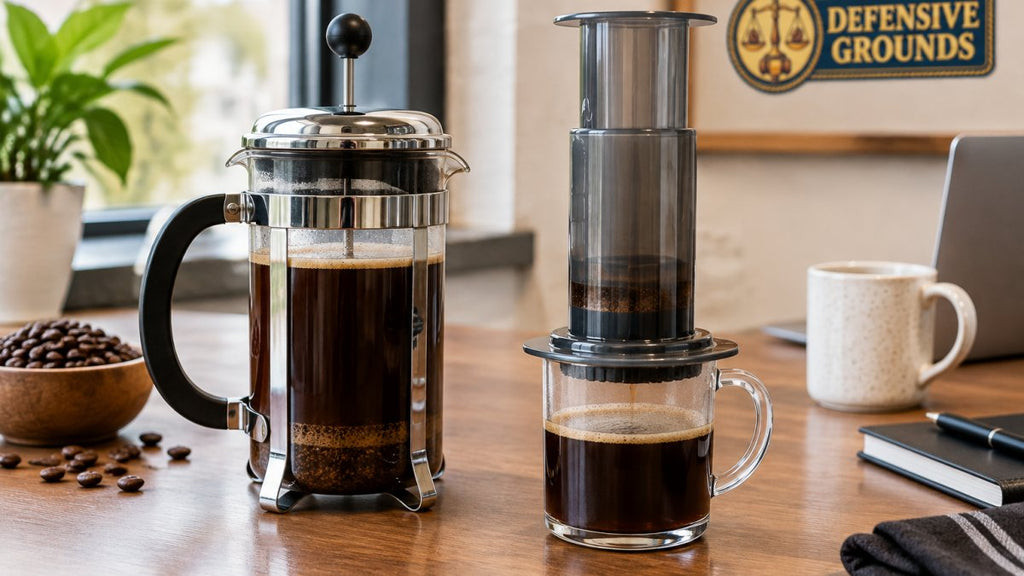
French press vs AeroPress coffee comes down to one trade-off: body versus clarity. The French press is an immersion brewer that steeps coarse grounds in hot water and strains them through a metal mesh, producing a heavy, full-bodied cup with sediment. AeroPress coffee is a pressure-assisted brewer that pushes water through a fine paper filter in roughly a minute and a half to three minutes, Coffee Hero's brewing comparison notes, yielding a smoother, cleaner cup. For a desk, the AeroPress wins on speed and cleanup. For a slow morning and a richer mug, the French press wins.
Side-by-Side Comparison at a Glance
| Factor | French Press | AeroPress |
|---|---|---|
| Brewing method | Immersion, static steeping | Pressure-assisted |
| Typical brew time | 4-5 minutes | 1.5-3 minutes |
| Capacity | 8 or more cups, size dependent | About 12-14 ounces |
| Filter | Metal mesh | Paper micro-filter |
| Grind | Coarse | Fine to medium-fine |
| Cup profile | Full-bodied, oily, some grit | Smooth, clean, low sediment |
| Cleanup | Rinse the carafe and mesh | Pop the puck, rinse the cap |
| Best for | Batch brewing, sharing | Single serving, speed |
This is the short answer, but the details below are where the decision actually gets made. For a wider look at every option, our coffee brewing methods chart puts both brewers in context.
French Press vs AeroPress Coffee Taste: Body, Clarity, and Sediment
Taste is the sharpest divide between these two brewers. The French press leaves coffee oils in the cup because a metal mesh filter catches grounds but not the fine particles and oils that carry texture. That is why a French press cup tastes full-bodied, rich, and sometimes slightly gritty at the bottom of the mug. The AeroPress uses a paper filter that traps those particles, so the result reads as smooth, bright, and clean.
Not everyone prefers the cleaner cup. Some drinkers on Coffee Forums' French press vs AeroPress discussion say the French press delivers the richer, stronger flavor they want, and find AeroPress coffee too smooth. That is a preference, not a defect. If you like texture and weight, the French press is the honest choice. If you want clarity and a cup you can drink fast without grit, the AeroPress delivers it.
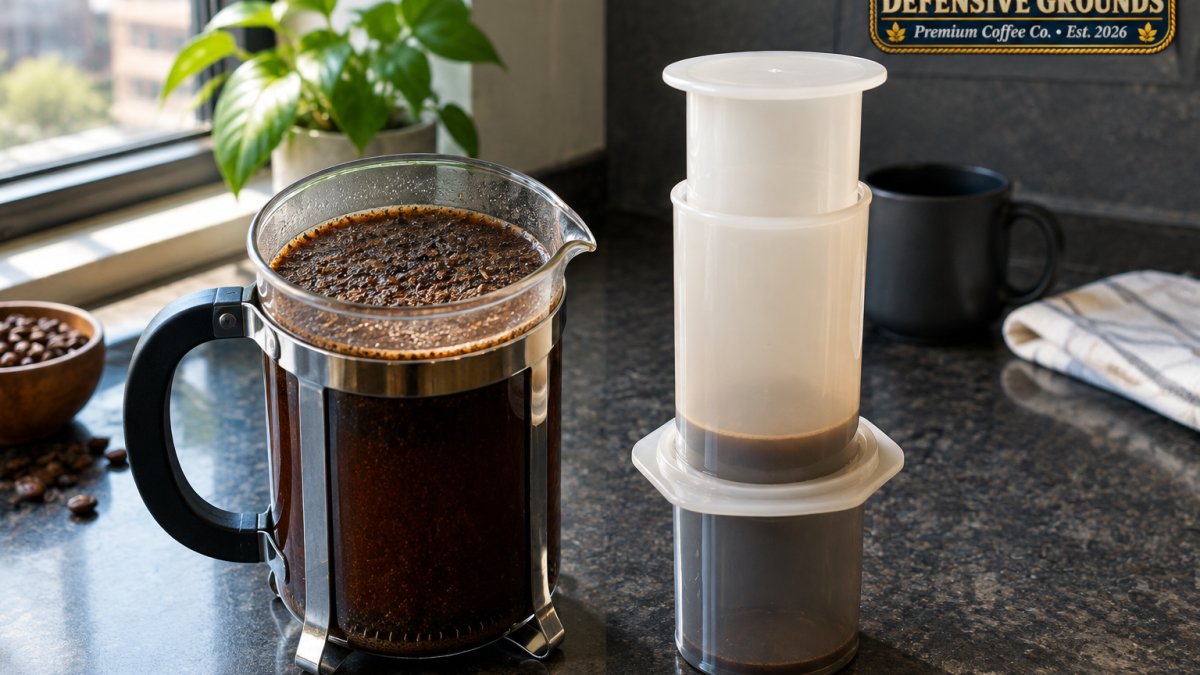
French Press vs AeroPress Grind Size and Brew Ratios
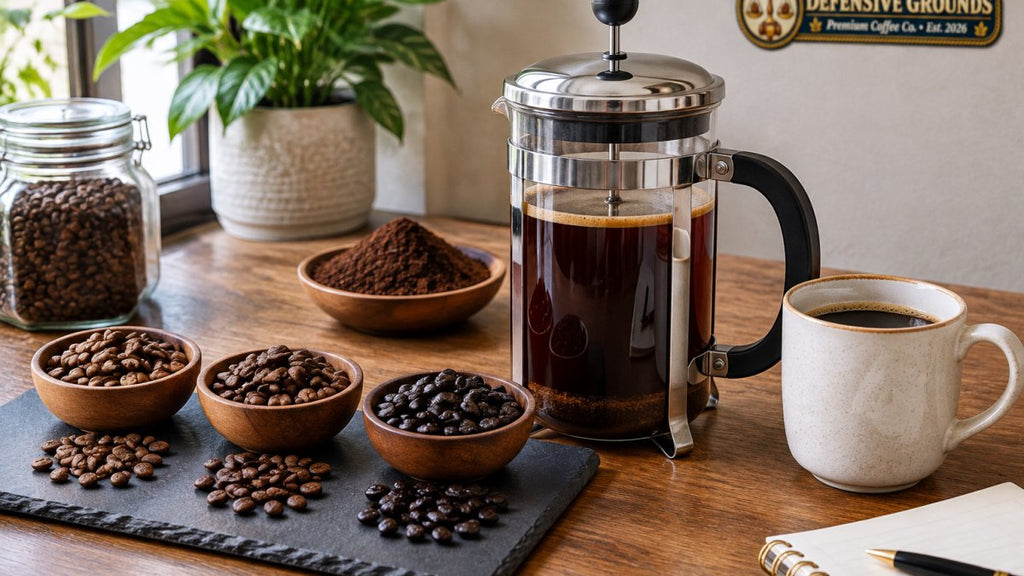
Grind size is where most disappointing cups begin, and the two brewers demand opposite approaches. The French press needs a coarse grind, roughly the texture of sea salt, because fine particles slip past the metal mesh and turn the cup muddy. The AeroPress tolerates a fine to medium-fine grind, closer to table salt, because the paper micro-filter catches what the mesh would let through.
The more useful comparison is a pair of controlled recipes. Use the same coffee, the same water, and the same dose so the only variables are grind and brewer. The following starting points are easy to adjust.
French press recipe (makes about 16 ounces, two 8-ounce cups):
- 30 grams coarse coffee (sea-salt texture)
- 500 grams water at 200°F
- Add all water at once, stir once, place the lid with the plunger up, and steep 4 minutes
- Press slowly over about 20 seconds, then pour immediately
AeroPress recipe (makes about 8 ounces, one strong cup):
- 15 grams fine-to-medium-fine coffee (table-salt texture)
- 220 grams water at 200°F
- Add water, stir 10 seconds, steep 1 minute, then press slowly over 30 seconds
These recipes are deliberately matched on ratio: both sit near 1:16 coffee to water by weight. That lets you taste the brewer rather than the recipe. If the French press cup tastes muddy, coarsen the grind by one setting. If the AeroPress cup tastes thin or sour, grind finer or add 5 seconds of steep time.
Watch out: a common mistake is to use the same grind for both brewers. A fine grind in the French press clogs the mesh and leaves sludge; a coarse grind in the AeroPress under-extracts and wastes the dose.
Brew Time, Capacity, and Cleanup on a Deadline
Brew time and cleanup decide which brewer survives a busy day. A French press needs four to five minutes of steeping plus a slow plunge, and the carafe then needs rinsing before the next round. The AeroPress finishes in about a minute and a half to three minutes, and cleanup is a single motion: press the grounds puck into the bin and rinse the cap. On a deadline, that gap matters.
Capacity cuts the other way. A French press can brew eight or more cups depending on its size, which suits a team. AeroPress and similar press brewers hold about 12 to 14 ounces, Handsome Wade's brewer capacity comparison reports, so it makes one strong cup or two smaller ones. Watch out: pressing an AeroPress too hard on a wobbly desk can slip and spill hot coffee, a handling complaint raised on Home-Barista's brewer discussion. Press slowly and keep the brewer flat.
Batch Brewing vs Single Serving
Batch brewing favors the French press and single serving favors the AeroPress. If four people want coffee at the same time, one French press does the job in one steep. If one person wants a precise cup at 9 p.m. during trial prep, the AeroPress makes exactly that without brewing a carafe nobody finishes. Neither is better; they solve different problems.
AeroPress vs French Press vs V60: Where Pour-Over Fits
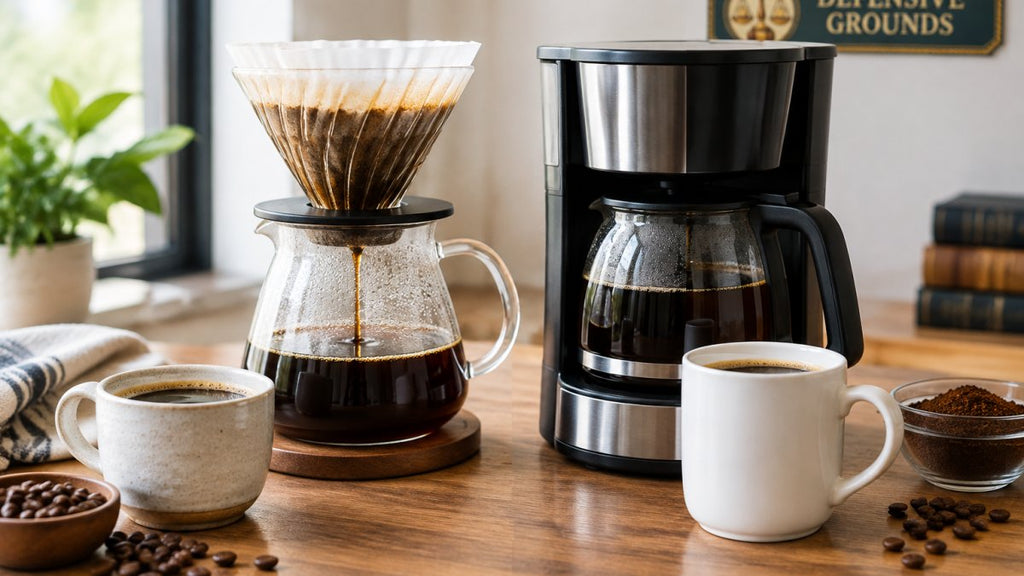
Pour-over enters the comparison as the clarity specialist. A V60 uses a paper filter and a slow, controlled pour, producing a bright, tea-like cup with more acidity than either press. The AeroPress gets close to that clarity with less technique and less time. The French press sits at the opposite end, heavy and textured. If you want to know whether the extra ritual is worth it, our honest review of whether pour over coffee is worth it breaks down the trade-off.
AeroPress vs French Press vs Drip Coffee: Office and Break Room Reality
Drip coffee wins on volume and loses on character. A batch drip machine keeps a full pot hot for a whole floor, which is why break rooms run on it. The French press and AeroPress both brew fresh by the cup or carafe, so quality holds up. The brewer choice is a practical decision for any office, as covered in our piece on why office coffee quality matters for productivity.
For taste differences between the two drip alternatives, our pour over vs drip coffee taste comparison covers which cup wins.
Cost of Ownership, Filters, and Physical Effort
Total cost of ownership favors the French press slightly, but the gap is smaller than most comparisons suggest. Both brewers are inexpensive one-time purchases that last years. The French press needs no consumables beyond coffee. The AeroPress runs on paper micro-filters, a small recurring cost that adds up over a year of daily brewing.
Physical effort is the underrated factor, and it is where the two brewers diverge most for real users. The French press requires a steady, slow plunge against resistance; the coarser the grind, the easier the press. The AeroPress requires a firm push, which some users with hand or wrist limitations find uncomfortable, especially when the brewer is hot.
Troubleshooting separates a frustrating brewer from a reliable one. For the French press, bitterness usually means the grind is too fine or the steep ran long; weak coffee means the dose was low or the water too cool.
Watch out: pressing an AeroPress too hard on a wobbly desk can slip and spill hot coffee. Press slowly, keep the brewer flat, and set it on a stable surface before you start.
Stocking Your Break Room With the Right Beans
Beans matter more than the brewer. A coarse grind for the French press and a fine grind for the AeroPress both reward fresh, specialty-grade coffee, because stale beans taste flat no matter how carefully you brew. Defensive Grounds roasts every bag to order, so it shows up fresh. For a team trying several profiles before committing, our best sellers sample pack includes six 2-ounce packs, from the dark 6Bean Blend to the medium Breakfast Blend and single origins from Peru, Mexico, and Bali, for $24.99.

Choosing a brewer is the easy part. Keeping a firm stocked with coffee that actually holds up through a filing deadline is the harder job, and that is where we come in. Defensive Grounds roasts specialty-grade coffee to order, ships free anywhere in the United States, and names every bag like a docket entry, so the break room gets a lift without anyone filing a complaint. Get started with Defensive Grounds and give your team coffee that understands the work.
Frequently Asked Questions
Does AeroPress make better coffee than French press?
Better depends on what you want in the cup. AeroPress coffee comes out smooth and clean because a paper filter traps most oils and grit. French press brewing leaves those oils in, giving a heavier, richer body that some drinkers prefer. Neither method is objectively superior. If you like a bright, sediment-free cup, the AeroPress wins. If you want a full-bodied mug with more texture, the French press is the better fit. Try both with the same beans before you commit.
What grind size should you use for French press and AeroPress coffee?
French press needs a coarse grind, roughly the texture of sea salt, because a fine grind slips past the mesh filter and leaves grit in the cup. AeroPress takes a medium-fine grind, closer to drip coffee, since the paper filter catches the finer particles. Grind consistency matters more than the exact setting. Adjust one notch at a time and taste before changing anything else.
How long does it take to brew coffee with an AeroPress compared with a French press?
AeroPress brewing runs about 1.5 to 3 minutes total, according to a published comparison from Coffee Hero. French press typically takes 4 to 5 minutes because the grounds steep before you press the plunger. The gap matters during a filing deadline or a short break between calls. Add cleanup time: the AeroPress pops out a puck of grounds and rinses fast, while a French press needs the mesh filter disassembled and scrubbed so old oils do not turn rancid.
Is an AeroPress or French press better for travel and small offices?
The AeroPress travels better. It is lightweight plastic, comes apart into compact pieces, and needs only a paper filter. A French press is glass or heavy metal, holds 8 or more cups in larger sizes, and is awkward to pack. For a small practice with a few people, an AeroPress plus a kettle covers single servings fast. For a conference room serving six or more, a French press batch makes more sense than brewing one cup at a time.
How do AeroPress and French press compare with pour-over and drip coffee?
Pour-over, such as a V60, gives the cleanest, brightest cup because water passes through a paper filter once, but it demands steady pouring and more attention. Drip coffee is the most hands-off and scales to a full office, though it sits on a hot plate and degrades over time. French press is the fullest-bodied and least filtered. AeroPress sits between pour-over and French press: fast, clean, and forgiving of small mistakes. Choose based on how many cups you need and how much attention you can spare.