Why Office Coffee Quality Matters for Productivity
Table of Contents
- Why Office Coffee Quality Matters for Productivity
- The Real Cost of Bad Coffee in a High-Pressure Firm
- How to Improve Employee Morale in the Office Through Better Coffee
- Best Coffee for the Office: A Practical Quality Framework
- Office Coffee Service Benefits You Can Measure
- Inclusive Coffee Programs for Hybrid and Mixed Teams
- Common Mistakes That Undermine Office Coffee
- Conclusion
- Frequently Asked Questions
Last Updated: October 21, 2026
Why Office Coffee Quality Matters for Productivity
Office coffee quality is the single most overlooked lever on workplace productivity in the legal profession. At Defensive Grounds, we built our entire company around one observation: nobody drinks more coffee than lawyers, and nobody's break room coffee gets less thought. The result is a workforce running on caffeine that tastes bad, hits unevenly, and drags morale down with every sip.
Here is the core problem. Cheap coffee gets treated as a line item, so it gets bought on price alone. But the people drinking it are billing in six-minute increments, and a bad cup shows up in their focus, their patience, and their output.
Below, we break down what caffeine actually does, why bad coffee costs more than good coffee, and how to build a program your team will actually use.
What Caffeine Actually Does to Alertness and Focus
Caffeine works by blocking adenosine, the chemical that builds up through the day and makes you feel tired. Block that signal and you stay alert longer.
That is the whole mechanism, and it matters because it explains the limits. Caffeine does not create energy. It delays the feeling of fatigue.
Dose is where most offices get it wrong.
What caffeine does well:
- Improves alertness and reaction time
- Supports concentration on repetitive, detail-heavy work
- Helps sustain attention during long meetings and document review
- Lifts mood slightly at moderate intake
What it does not do:
- Replace sleep
- Improve complex reasoning once you are already exhausted
- Work the same way for everyone
Individual differences are real. Genetics, tolerance, medications, and pregnancy all change how a person metabolizes caffeine. A coffee program that assumes one dose fits all will over-serve some people and under-serve others.
That is the first thing most guides miss: the goal is not the strongest cup. It is a reliable, well-made cup that people can dose themselves.
The Real Cost of Bad Coffee in a High-Pressure Firm
Bad coffee is not a small annoyance. It is a daily tax on the people doing your most demanding work.
Picture a junior associate on hour eleven of trial prep. The pot has been sitting on a burner since morning.
That cycle repeats across the firm, every day, and it produces three costs.
Wasted spend. People stop drinking the free coffee and buy it elsewhere. The firm pays for a service nobody uses, plus the coffee shop runs.
Lost time. Someone leaves the office to get a decent cup.
Lowered standards. When the break room is an afterthought, it signals that the people using it are an afterthought too. That perception is hard to undo.
A common mistake is treating coffee as a commodity purchase.
Watch Out
The most expensive coffee mistake is buying in bulk on price alone and letting it sit in a supply closet for months. Stale beans taste flat and bitter, so people drink less, and the "savings" disappear into a break room nobody uses.
How to Improve Employee Morale in the Office Through Better Coffee
The fastest way to improve employee morale in the office is to fix the thing your team touches every single day. Coffee is that thing.

Morale is not built by a quarterly email. It is built by small, repeated signals that someone thought about the people working there.
There is a social layer too. The coffee station is where the paralegal and the partner end up in the same conversation. It is where a hard morning gets reset.
The practical moves are simple:
- Upgrade the beans before you upgrade the machine
- Keep the station clean and stocked, always
- Offer a decaf option so nobody is excluded
- Add a lighter roast alongside a darker one
- Make the good stuff easy to find and easy to brew
What most firms get wrong is spending on a fancy machine and filling it with cheap coffee. The machine is not the problem. The beans are.
Pro Tip
Rotate your coffee supply so the oldest bag gets used first, and write the roast date on the bag when it arrives. Freshness is the one variable that changes taste more than equipment, grind, or technique.
Best Coffee for the Office: A Practical Quality Framework
The best coffee for the office is fresh, consistently roasted, and matched to how your team actually drinks it. That is the whole answer. Everything else is detail.
Use this framework to judge any coffee you are considering. Score each item from one to five and total it up.
| Criterion | What to Check | Why It Matters |
|---|---|---|
| Roast date | Printed date, not a "best by" | Freshness drives flavor more than anything |
| Roast level | Medium is the safe default | Balances body and acidity for most palates |
| Grind match | Whole bean or matched to your brewer | Wrong grind ruins good beans |
| Dose consistency | Scoop or scale provided | Even dosing means even caffeine |
| Origin clarity | Named regions or blend stated | Signals a roaster who knows the product |
| Decaf available | Same quality, not an afterthought | Keeps the program inclusive |
A roaster that prints a roast date and ships to order will beat a cheaper bag with a vague shelf life every time.
Freshness, Roast Level, and Dose Per Cup
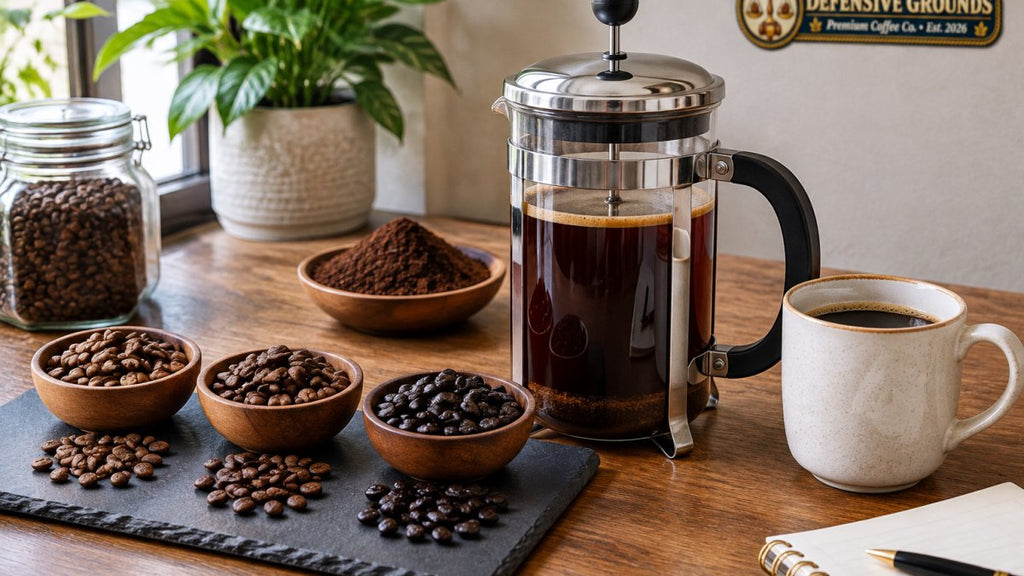
Freshness is the variable that separates good coffee from forgettable coffee. Coffee is best in the weeks after roasting, not months. Oxygen and time flatten the aromatics that make a cup taste like something.
Roast level is the second lever. Light and medium roasts keep more of the origin character and tend to taste brighter. Darker roasts taste heavier and more bitter.
Dose is the third. A consistent scoop per cup means a consistent caffeine hit, which means fewer surprises at 3 p.m.
Our own House Blend is a medium roast built for exactly this: smooth, clean, and consistent, with notes of nutty chocolate and mild citrus. It is the kind of cup that does not need defending in a partner meeting.

Key Takeaway
Judge office coffee on freshness, roast level, and dose consistency before you judge it on price. Those three variables predict satisfaction better than brand or equipment.
Office Coffee Service Benefits You Can Measure
The benefits of a better office coffee service show up in places you can track. You just have to decide what to measure before you switch.
Start with usage. Count how many cups the break room produces in a week, then compare it after the change. Rising usage is a good sign: it means people stopped leaving to buy coffee.
Then look at the softer signals. Ask your team one question in a short survey: how satisfied are you with the break room? Track it quarterly. You are not looking for a perfect score. You are looking for a trend.
Metrics worth tracking:
- Cups brewed per week
- Spend on outside coffee runs
- Break room satisfaction score
- Supply waste and expired stock
- Time lost to off-site coffee trips
Tracking Productivity and Return on Investment
Return on investment for a coffee program is not a clean spreadsheet number, and anyone who tells you otherwise is guessing. You can still build a defensible case.
Add up what the firm currently spends on coffee service, outside runs, and wasted stock. Then compare it to the cost of a fresh, roasted-to-order program. If the new program costs less than the old spend plus the waste, it pays for itself before you count a single minute of recovered focus.
The bigger return is harder to invoice. A team that is not leaving the building for coffee is a team that is at their desk. That is the number worth arguing for.
Pro Tip
Run the new coffee alongside the old for two weeks before you cancel anything. Let people compare directly. Adoption goes up when the switch feels like a choice, not a decree.
Inclusive Coffee Programs for Hybrid and Mixed Teams
A coffee program that only works for people in the building on Tuesday is not a program. It is a perk for some of the team.
Hybrid schedules break naive coffee planning. If half the firm is remote on Fridays, a full pot brewed for the office is waste.
Fix it with three simple rules.
Stock to the schedule. Match supply to who is actually in the building each day. Fewer people in means smaller batches, brewed more often.
Cover dietary and health needs. Offer decaf at the same quality as regular. Keep a non-dairy option available.
Extend the perk. Ship bags to remote staff or send them as client gifts so the program reaches everyone on the team.
That last point matters more than it sounds.
Common Mistakes That Undermine Office Coffee
Most office coffee problems come from a short list of repeat mistakes.
Buying on price alone. The cheapest bag costs more in the long run because people stop drinking it.
Letting beans go stale. Bulk buying without rotation means the last third of the supply tastes like cardboard.
Skipping decaf. Leaving out decaf excludes anyone who limits caffeine, and it signals the program was not thought through.
Never cleaning the equipment. Old oils in a brewer turn every fresh bag bitter within a day.
No feedback loop. If nobody asks the team what they want, the program drifts toward whatever was easiest to order.
Treating it as a one-time purchase. Coffee is a recurring supply.
Watch Out
Skipping regular cleaning is the fastest way to ruin good beans. Residual oils go rancid and turn a fresh roast bitter overnight. A five-minute cleaning routine protects every bag you buy.
Conclusion
The firms that win on talent are the ones that sweat the small stuff, and the break room is small stuff that compounds. Better coffee means sharper focus, higher morale, and a team that stays at their desks instead of leaving for a decent cup.
At Defensive Grounds, we roast specialty-grade coffee to order for people who bill in six-minute increments. Every bag ships fresh, not after months on a shelf. Our House Blend delivers a smooth, consistent medium roast for the whole team, Breakfast Blend + adds extra caffeine for the long nights, and Gourmet Donut Shop brings a lighter, sweeter option for the break room. Free shipping anywhere in the United States.

Get started with Defensive Grounds and give your team a coffee that finally understands the work.
Frequently Asked Questions
Does better office coffee improve employee productivity?
It can, but the effect runs through specific channels rather than a single magic bean. Caffeine at moderate doses (roughly 75-150 mg, about one to two cups) supports alertness and sustained attention during mentally demanding tasks, which matters for long document reviews and trial prep. Quality matters because fresh, well-roasted coffee is something people actually drink and enjoy, so the perk gets used instead of abandoned. Pair it with reasonable dosing and access to water, and the productivity gains show up in fewer mid-afternoon crashes and better focus.
How does coffee affect focus and concentration at work?
Caffeine blocks adenosine, the chemical that builds up through the day and makes you feel tired, so you stay alert longer. For focus-heavy legal work like contract review or deposition prep, that translates to steadier attention. The catch is dose and timing: too much late in the day disrupts sleep, which erases the benefit the next morning. A practical rule is to keep caffeine to the earlier part of the day and treat a 3 p.m. cup as optional, not automatic. Hydration alongside coffee also helps concentration stay level.
What makes office coffee taste better?
Four things do most of the work: freshness, grind, water, and dose. Coffee roasted recently and used within a few weeks of the roast date tastes noticeably better than beans that sat on a shelf for months. Grinding right before brewing preserves aroma. Water should be filtered, since chlorine and hard minerals flatten flavor. And dose matters: most bad office coffee is simply under-dosed, using too few grounds for the volume of water. Fix those four and even a basic brewer produces a cup people look forward to.
How can employers improve coffee quality in the office?
Start with the supply, not the machine. Choose a roaster that ships fresh and offers a medium roast that suits most palates, like a smooth breakfast blend or a balanced house blend. Standardize dosing so staff aren't guessing, add filtered water, and set a simple cleaning schedule for the brewer. Then plan for individual differences: keep a higher-caffeine option and a decaf available so nobody is left out. Finally, ask the team what they actually drink. A short survey beats guessing, and it costs nothing.