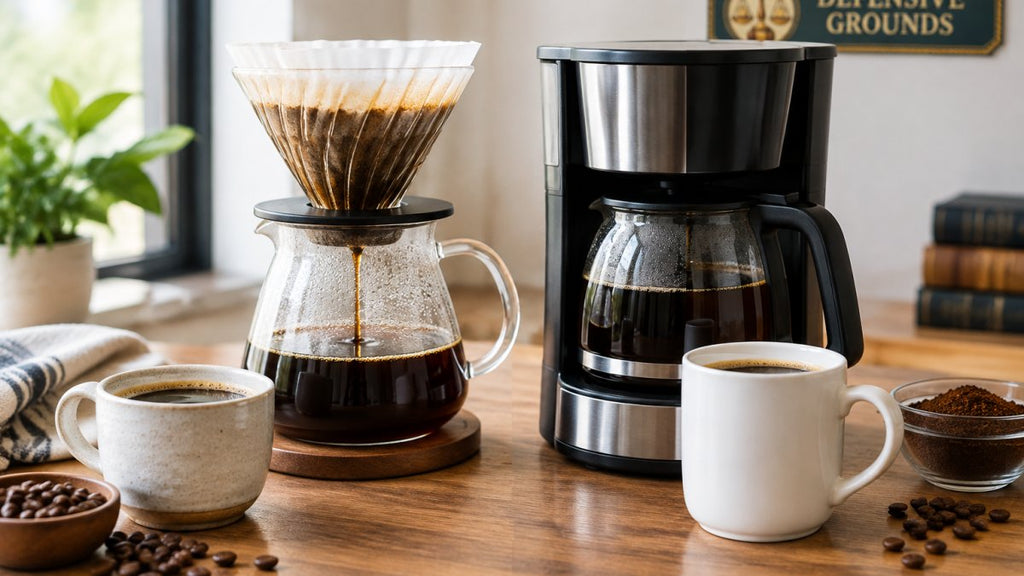
Coffee Brewing Methods Chart: The Complete Guide
Last Updated: November 2, 2026
Quick Summary
A coffee brewing methods chart pairs each brewing style with its ideal grind size, coffee-to-water ratio, water temperature, and brew time, so you can compare nine methods side by side instead of guessing. Every method falls into one of two families: immersion, where grounds steep in water, or percolation, where water passes through a bed of grounds.
- Read down a column, not across a row: finer grinds need shorter contact time to avoid over-extraction.
- A 1:16 ratio means one gram of coffee to sixteen grams of water; stronger cups sit at 1:15.
- Grind sizes run from extra fine for Turkish coffee and espresso to very coarse for cold brew.
- Brew times range from 25-30 seconds for espresso to 12-18 hours for cold brew.
- Sour, thin coffee is under-extracted: grind finer, raise the temperature, or extend brew time.
Table of Contents
- Why a Coffee Brewing Methods Chart Beats Guesswork
- The Coffee Brewing Methods Chart: Every Method at a Glance
- Coffee-to-Water Ratio by Brew Method
- Coffee Grind Size Chart: Match the Grind to the Method
- Coffee Brewing Times: How Long Each Method Takes
- Water Temperature and Water Quality: The Variables Behind the Chart
- The Best Coffee Brewing Method for Your Taste, Budget, and Cleanup Tolerance
- Troubleshooting: How to Adjust When the Cup Tastes Wrong
- Frequently Asked Questions
Why a Coffee Brewing Methods Chart Beats Guesswork
A coffee brewing methods chart is a reference sheet that pairs each brewing style with its ideal grind size, coffee-to-water ratio, water temperature, and brew time. It turns a shelf of equipment into repeatable results.
The stakes are higher than most people assume. Researchers at the UC Davis Coffee Center spent years collecting data to overhaul the decades-old Coffee Brewing Control Chart, because the original framework no longer matched how people actually brew and taste.
Here's what most guides get wrong: they treat ratios and temperatures as fixed laws. They're starting points. Below, we'll show you exactly how to read the variables, pick a method, and adjust when the cup tastes off.
The Coffee Brewing Methods Chart: Every Method at a Glance
Every brewing method falls into one of two families: immersion, where grounds steep in water, or percolation, where water passes through a bed of grounds. That single distinction explains most of the differences in body, clarity, and cleanup. The chart below standardizes the variables across nine methods so you can compare them side by side instead of hunting through separate ratio, grind, and temperature tables.
| Method | Family | Grind | Ratio (coffee:water) | Brew Time | Water Temp | Typical Serving | Difficulty | Cleanup |
|---|---|---|---|---|---|---|---|---|
| Drip coffee maker | Percolation | Medium | 1:16 | 5-8 min | 195-205°F | 8-12 cups | Easy | Rinse carafe; descale monthly |
| Pour-over (V60) | Percolation | Medium-fine | 1:16 | 3-4 min | 195-205°F | 1-2 cups | Moderate | Discard filter; rinse cone |
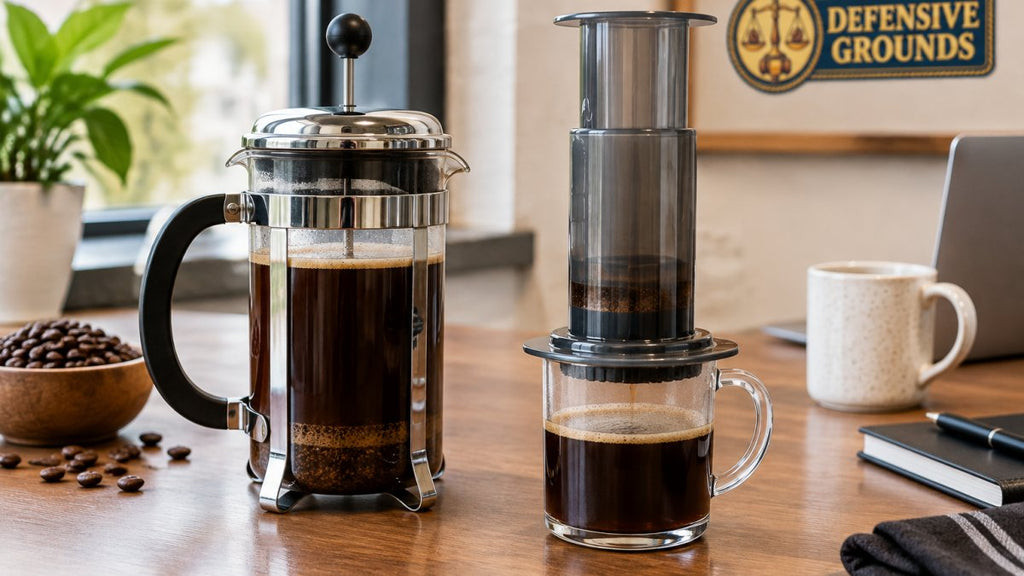
| French press | Immersion | Coarse | 1:15 | 4 min steep | 195-205°F | 3-4 cups | Easy | Rinse plunger and carafe |
| AeroPress | Immersion | Fine-medium | 1:13 | 1-2 min | 185-205°F | 1-2 cups | Easy | Rinse chamber; wipe seal |
| Cold brew | Immersion | Very coarse | 1:8 concentrate | 12-18 hrs | Cold | 4-8 cups concentrate | Easy | Rinse filter; refrigerate |
| Espresso | Percolation | Fine | 1:2 | 25-30 sec | 195-205°F | 1-2 oz | Hard | Flush group; backflush weekly |
| Moka pot | Percolation | Fine | 1:10 | 4-6 min | 195-205°F | 2-6 oz | Moderate | Rinse all parts; no soap |
| Turkish coffee | Immersion | Extra fine | 1:10 | 3-5 min | Just off boil | 2-3 oz | Moderate | Rinse cezve; discard grounds |
| Instant | N/A | N/A | To taste | Under 1 min | Hot water | 1 cup | Easy | Rinse mug |
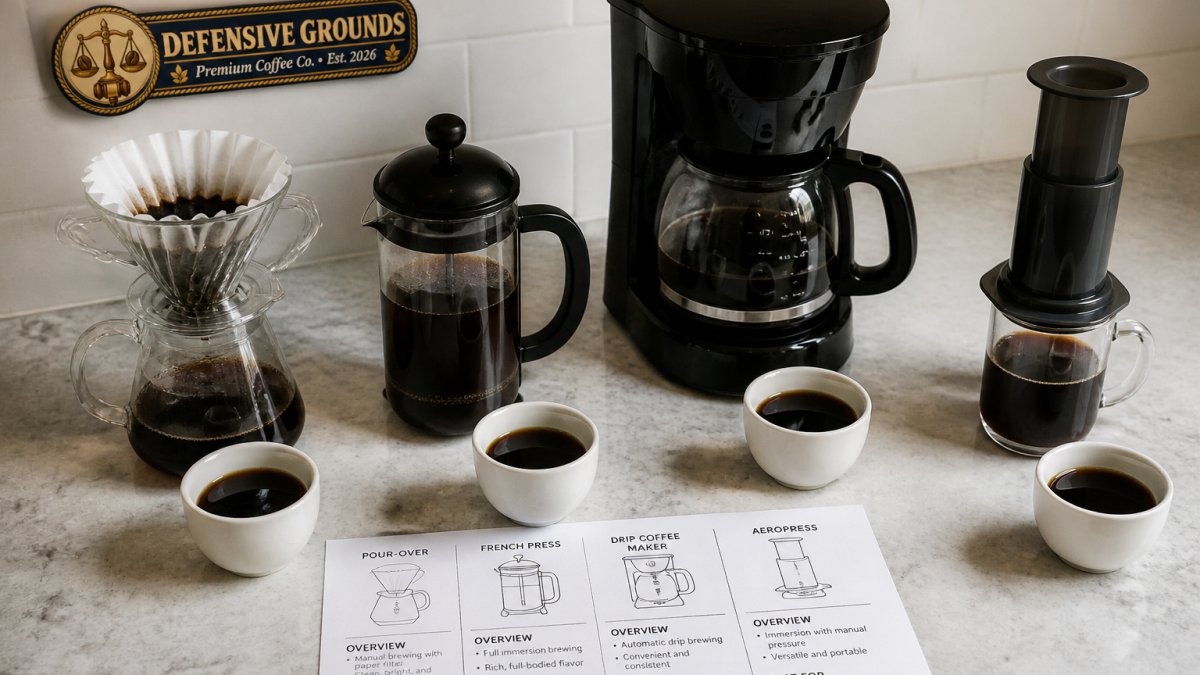
For the no-equipment end of the chart, our instant coffee covers the office emergency.

How to Read the Chart
Read down a column, not across a row. Grind size and brew time move together: the finer the grind, the faster water extracts flavor, so the contact time must shorten. A fine grind in a French press over-extracts into bitterness.
The difficulty and cleanup columns are there because the best method is the one you will actually repeat. A French press rinses in under a minute; a pour-over needs a fresh filter each time; an espresso machine rewards weekly backflushing with consistent shots.
Choosing a Method by Taste Preference
Flavor clarity, body, strength, and acidity map predictably to method family. Percolation methods with paper filters, pour-over and drip, produce the clearest cup because the filter traps oils and fine particles. Immersion methods like the French press keep those oils in the cup, which reads as heavier body and rounder texture. Espresso concentrates everything into a small volume, so intensity is the point.
- For clarity and control: pour-over
- For body with minimal gear: French press
- For speed at a desk: AeroPress
Pro Tip
Print the chart and tape it inside a cabinet door. The two columns you will consult most are grind and ratio, everything else follows from those.
Coffee-to-Water Ratio by Brew Method
The coffee-to-water ratio by brew method is the single variable that most changes strength, and it is the easiest to control with a kitchen scale. A 1:16 ratio means one gram of coffee to sixteen grams of water. Stronger tastes call for 1:15; lighter, more tea-like cups sit at 1:17. The ratios below are starting points, not laws, adjust one step at a time until the cup lands where you want it.
| Method | Ratio | Coffee per 8 oz (240 g) water | Coffee per 12 oz (355 g) water | Coffee per 1 liter water |
|---|---|---|---|---|
| Drip coffee maker | 1:16 | 15 g | 22 g | 63 g |
| Pour-over (V60) | 1:16 | 15 g | 22 g | 63 g |
| French press | 1:15 | 16 g | 24 g | 67 g |
| AeroPress | 1:13 | 18 g | 27 g | 77 g |
| Cold brew concentrate | 1:8 | 30 g | 44 g | 125 g |
| Espresso | 1:2 | 18 g dose yields ~36 g shot | , | , |
Measurement Conversions and Serving Examples
A scale is the most reliable tool, but most kitchens do not have one on day one. These conversions bridge the gap.
- Grams to tablespoons: one level tablespoon of ground coffee weighs roughly 5-6 g. A standard 8 oz mug at 1:16 takes about 2.5 level tablespoons.
- Milliliters to cups: 1 cup is about 237 mL, so 8 oz is roughly 240 mL and 12 oz is roughly 355 mL. A 1-liter batch is about 4.2 cups.
- Scoops: a standard coffee scoop holds about 2 tablespoons, or 10-12 g.
Worked recipes for common serving sizes:
- One 8 oz cup (drip or pour-over): 15 g coffee to 240 g water at 1:16, about 2.5 level tablespoons.
- A 12-cup drip batch: most 12-cup machines brew about 60 oz, or roughly 1.8 liters. At 1:16 that is about 110 g coffee to 1.8 liters water, roughly 9 scoops.
- French press for four (32 oz): 60 g coarse grounds to 900 g water at 1:15, about 5 scoops.
Watch Out
Volume measurements drift with grind size, a scoop of coarse grounds weighs less than a scoop of fine grounds because the coarse particles pack less densely. If you switch methods, re-weigh once with a scale and note the scoop count for that grind.
Strength vs. Extraction: Two Separate Dials
Strength comes from the ratio; flavor balance comes from extraction. If the cup tastes weak but not sour, increase the dose rather than the brew time. If it tastes sour or thin, the problem is extraction, grind finer, raise the temperature, or extend contact time.
Key Takeaway
Start every new method at the chart ratio, weigh your dose once, and adjust in small steps. Two or three brews will tell you whether your taste runs stronger (1:15) or lighter (1:17) than the baseline.
Coffee Grind Size Chart: Match the Grind to the Method
A coffee grind size chart runs from extra fine, like powdered sugar, to very coarse, like sea salt. Match the grind to the brew time: short brews need fine grounds, long steeps need coarse ones.
- Extra fine: Turkish coffee, espresso
- Fine: AeroPress, moka pot
- Medium-fine: pour-over, hand drip
Coffee Brewing Times: How Long Each Method Takes
Coffee brewing times range from 25 seconds for espresso to 18 hours for cold brew. The clock starts when water meets grounds, and every method on the chart has a window where extraction lands in the sweet spot.
Espresso runs 25-30 seconds. AeroPress finishes in one to two minutes. Pour-over takes three to four minutes of active pouring. Drip machines cycle in five to eight minutes. French press steeps four minutes before you plunge.
Water Temperature and Water Quality: The Variables Behind the Chart
Water temperature matters because heat drives extraction. The commonly cited range of 195-205°F works as a starting point for hot methods, not a universal prescription, as temperature guidance by brewing method notes.
Water quality is the variable nobody charts.
Freshness sits right beside it. Our guide on how to keep office coffee fresh covers storage for break room supply.
The Best Coffee Brewing Method for Your Taste, Budget, and Cleanup Tolerance
The best coffee brewing method is the one you'll actually repeat, because consistency beats equipment every time. A 2023 study in the Journal of Food Quality tested four filter methods, Pure Brew, V60, AeroPress, and French press, and found the person brewing influenced reproducibility as much as the method itself.
- For clarity and control: pour-over
- For body with minimal gear: French press
- For speed at a desk: AeroPress
Cleanup and cost separate these quickly. A French press rinses in under a minute; a pour-over needs a fresh filter each time. A drip machine wins on volume but needs descaling.
Once you've picked a method, try beans suited to it. Our best sellers sample pack lets you test six roasts in 2oz packs, and the single origin favorites sample pack lets you compare single origin coffees side by side.
Troubleshooting: How to Adjust When the Cup Tastes Wrong
Sour, thin coffee is under-extracted: grind finer, raise the water temperature, or extend the brew time.
Weak but not sour? Increase the dose, not the brew time. Strength comes from the ratio; flavor balance comes from extraction.
If the cup still tastes flat, check the beans before the equipment. Our step-by-step guide on how to evaluate fresh coffee beans walks through what to look for.
We built Defensive Grounds for people who run on caffeine and deadlines, so every bag is specialty-grade and roasted to order rather than sitting on a shelf. Our cold brew coffee is blended specifically for cold brew, and our single serve coffee capsules are a single serve option.


Frequently Asked Questions
What is the difference between pour-over, French press, and drip coffee?
Pour-over runs hot water through a paper filter in stages, giving a clean, bright cup with high clarity. French press is immersion brewing: grounds steep fully in water, then a metal mesh strains them, leaving more oils and body. Drip coffee makers automate the pour-over idea with a basket filter and a reservoir. In chart terms, pour-over uses a medium-fine grind and about 3 minutes, French press uses a coarse grind and 4 minutes, and drip sits in between. Each method rewards a slightly different coffee-to-water ratio.
What coffee-to-water ratio should you use for each brewing method?
A general starting point is 1:15 to 1:17 by weight, meaning one gram of coffee for every 15 to 17 grams of water. Drip and pour-over sit comfortably around 1:16 to 1:17 for a balanced cup. French press often lands near 1:15 for more body. Cold brew concentrates much stronger, typically 1:5 to 1:8 before dilution. Treat every figure as a starting point, then adjust based on taste. If the cup tastes weak, tighten the ratio before changing anything else.
Which coffee brewing method makes the strongest coffee?
Strength is about dissolved solids, not caffeine alone. Espresso and cold brew concentrate deliver the highest concentration per ounce. Cold brew steeps coarse grounds for 12 to 18 hours, pulling out a dense, low-acid concentrate you dilute to taste. French press runs stronger than drip because the metal filter lets more oils and fine particles through. If you want a strong cup without special equipment, a tighter ratio in a French press gets you there fastest.
Which coffee brewing method is easiest for beginners?
A drip coffee maker is the lowest-effort entry point: add water, add a medium grind, press start. An AeroPress runs a close second, with a forgiving 1 to 2 minute brew and simple cleanup. If you want to learn pour-over, start with a medium grind and a 1:16 ratio, and expect a few uneven cups before it clicks. Whichever method you choose, fresh, consistently ground coffee matters more than the equipment.
How do you choose the right coffee grind size for each brewing method?
Match grind to contact time. Short brews need fine grounds, long brews need coarse ones. Espresso takes a fine grind, pour-over and AeroPress take medium-fine to medium, drip takes medium, and French press and cold brew take coarse. A coffee grind size chart gives you the starting point; your grinder's burrs and the coffee's roast level shift it slightly. If a brew runs too fast and tastes sour, grind finer. If it runs slow and tastes bitter, grind coarser.
Can I use the same coffee for every brewing method on the chart?
Yes, with adjustments. A medium roast works across drip, pour-over, French press, and AeroPress. Darker roasts suit cold brew and espresso, where their deeper flavors hold up to long extraction. The variable that changes most is grind size, not the bean itself. Keep one reliable house coffee on hand and dial in the grind and ratio per method. That approach keeps a break room simple without sacrificing cup quality.
Your break room deserves better than a burnt pot and a shrug. Get started with Defensive Grounds and give every long night, early deposition, and six-minute increment a cup that holds up.