7 Reasons Custom Coffee Packaging Wins on Branding
Last Updated: October 28, 2026
Quick Summary
Yes, custom coffee packaging is good for branding because it carries your identity across every touchpoint, from the bag on a desk to the gift a client unwraps. Design choices like color, typography, and materials shape buyer expectations before the first sip, but packaging cannot rescue weak coffee or make a brand memorable on its own.
- Custom-printed flexible bags carry setup and plate charges that get cheaper per bag as your run grows.
- Runs of 500 to 2,500 bags can be economically viable for specialty roasters, per ARRSYS' report.
- A stock bag with a custom label runs about $0.23, according to Inkroast's 2026 cost analysis.
- Set a baseline of four to eight weeks of data plus a control SKU before changing any packaging.
- Ask printers for the per-unit price, setup charge, and reorder MOQ before committing.
Table of Contents
- Why Custom Coffee Packaging Earns Its Place in Branding
- How Coffee Packaging Design Shapes First Impressions
- Coffee Packaging Ideas That Stand Out in a Crowded Market
- Custom Coffee Bags vs. Stock Bags: A Decision Framework
- Coffee Packaging Labels: The Low-Cost Route to Branding
- Protecting Freshness: Light, Oxygen, and Moisture Barriers
- Measuring Whether Packaging Actually Moves the Needle
- Choosing Packaging for Your Firm's Break Room or Client Gifts
- Frequently Asked Questions
Why Custom Coffee Packaging Earns Its Place in Branding
Yes, custom coffee packaging is good for branding, with one condition: the design has to do work a stock bag can't. Packaging is a marketing asset a customer can hold, read, and keep on a counter.
Here's the honest version most guides skip. Packaging can't rescue weak coffee, and it can't make a brand memorable on its own. What it does well is carry identity across every touchpoint: the bag on a desk, the label on a break room shelf, the gift a client unwraps. Design choices shape expectations before the first sip, according to ClearBags' 2026 packaging trend analysis, which notes that color, design, and material all influence how buyers judge coffee.
Below, we'll discuss custom packaging, stock bags, and ways to measure branding impact.
How Coffee Packaging Design Shapes First Impressions
Coffee packaging design is the system of visual and structural choices, bag format, colors, type, materials, that tells a buyer what kind of coffee they're holding before they open it, in about the time it takes to pick a bag off a shelf.
That window is short and crowded. A shopper scanning a shelf or gift table judges quality, price tier, and personality in seconds. Good design answers three questions fast: who made this, what does it taste like, and who is it for.
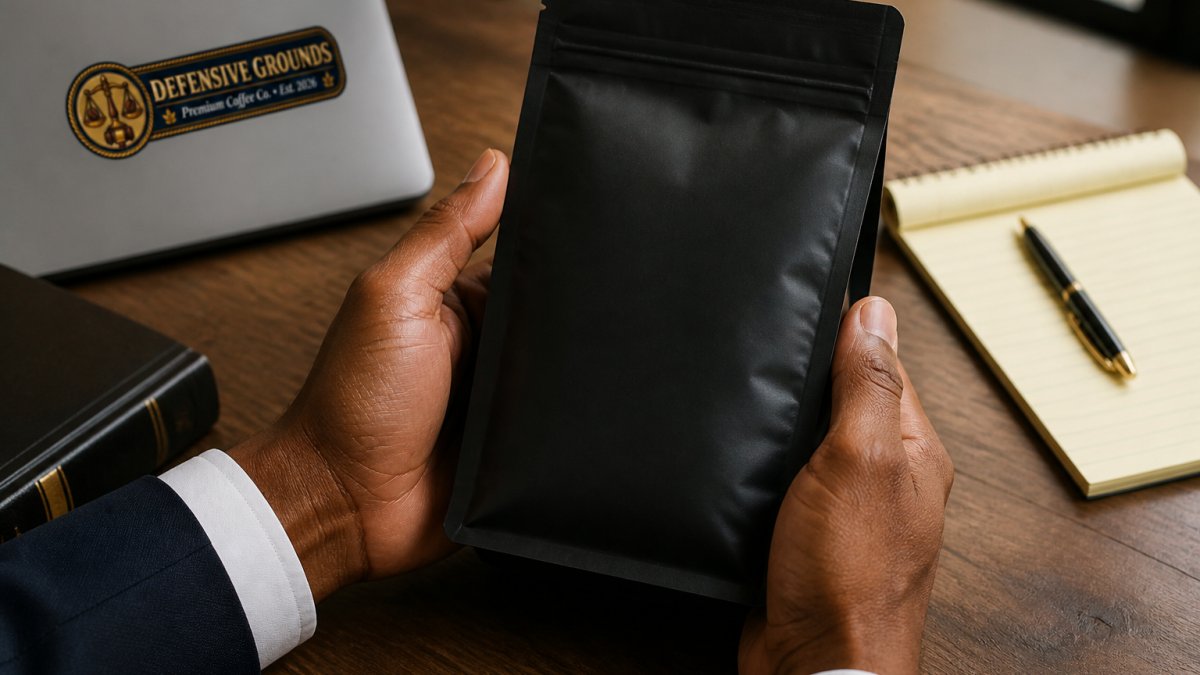
Logo, Color Palette, and Typography Working Together
Three elements do most of the heavy lifting, and they only work as a set.
- Logo: clear and legible at arm's length, not just on a screen
- Color palette: two or three colors that hold up in dim break rooms and on phone screens
- Typography: readable roast and origin details, not decorative type that hides them
A strong logo in the wrong color on the wrong stock reads as noise. Consistency across every SKU is what builds brand recognition over time.
Communicating Flavor, Origin, and the Brand Story
Flavor and origin belong on the front, in plain words. "Dark chocolate, low acidity, single origin" tells a buyer more than a poetic paragraph. The brand story can live on the back.
Story-driven illustration is one of the design elements that shows up in award-winning coffee packaging, per Perfect Daily Grind's 2026 design guidance. The point isn't decoration. It's giving the buyer a reason to pick your bag over the identical-looking one beside it.
Coffee Packaging Ideas That Stand Out in a Crowded Market
Standing out rarely means being the loudest bag on the shelf. It means being the most specific. Generic "premium coffee" language blends in; a clear point of view does not.
Here are coffee packaging ideas that hold up in practice:
- A named roast system instead of numbered blends, so customers order by name
- One signature color used across every product line for instant shelf recognition
- A tactile finish on the front panel, since texture reads before text does
- A short story panel that explains who the coffee is roasted for
- A consistent label position so your bags look like a family, not a collection
Consistent label position matters more than people expect: when every bag shares a layout, a customer spots your product across a room.
Custom Coffee Bags vs. Stock Bags: A Decision Framework
Custom coffee bags make sense when volume, margin, and brand visibility justify the setup cost. Stock bags with printed labels make sense when you're testing a roast, running short cycles, or protecting cash flow. The useful question is which fits your stage, run size, and cash position right now.
The decision can involve setup and plate charges, minimum order quantities (MOQs), lead time, and flexibility to change the design later.
The Four Cost Mechanics That Decide It
- Setup and plate charges. Custom-printed flexible bags require printing plates or digital setup per design. That cost is fixed, so it gets cheaper per bag as your run grows and more expensive per bag as your run shrinks. Stock bags carry no design-specific setup because the printer amortizes it across many buyers.
- Minimum order quantities. Custom printers typically set MOQs in the hundreds to low thousands per SKU. Stock bags and labels can be ordered in much smaller quantities, which matters when you're validating a new roast.
- Lead time. Custom print runs usually add production and proofing time on top of standard fulfillment. Stock bags plus labels can often ship faster, which lets you react to a roast that sells out or a design you want to test.
- Flexibility. Once plates are made, changing a color, a roast name, or a flavor panel means new setup. Labels can be redesigned and reprinted in small batches, so a label-based system stays flexible while you iterate.
A Stage-Based Decision Framework
| Your Situation | Best Choice | Why |
|---|---|---|
| Testing a new roast | Stock bag + label | Low commitment, fast to market, no plate cost |
| Under ~500 units per SKU | Stock bag + label | Custom setup rarely amortizes at this volume |
| 500-2,500 units per run | Custom printed bag | Runs this size can justify setup for specialty roasters |
| Retail shelf placement | Custom printed bag | Shelf appeal needs full-panel print and consistent color |
| Client gifting program | Custom bag or premium label | Unboxing is part of the gift and justifies the spend |
| Multiple SKUs, tight cash | Hybrid: stock bags, branded labels | Consistent look across the line at lower cost |
The middle rows are where most roasters get stuck. A 2026 industry article notes that runs of 500 to 2,500 bags can be economically viable for specialty roasters, per ARRSYS' specialty coffee packaging trends report. Below that, you're usually paying for setup you can't amortize.
Cost is the part most guides gloss over. According to Inkroast's 2026 packaging cost analysis, a stock bag with a custom label runs about $0.23, and custom-printed bags are not cheaper at small volumes. The same analysis puts full packaging design projects in a wide range, so budget accordingly and ask your printer for a per-unit quote at your actual run size rather than a headline price.
Pro Tip
Ask every printer for three numbers before you commit: the per-unit price at your current run size, the setup or plate charge, and the MOQ for a reorder. Those three numbers, not the headline bag price, tell you what custom packaging really costs at your stage.
If you're still deciding what goes inside the bag, our guide on how to source fresh roasted beans wholesale covers the supply side.
Coffee Packaging Labels: The Low-Cost Route to Branding
Coffee packaging labels are one branding option for small firms and new roasters. A well-designed label on a stock bag can look deliberate.
What makes a label work:
- Die-cut shape that differs from the standard rectangle
- Matte or textured stock for a premium feel without custom printing
- Consistent placement across every bag in the line
- Front-panel essentials: logo, roast level, origin, flavor notes
- A back panel with brewing guidance and your story
Protecting Freshness: Light, Oxygen, and Moisture Barriers
Freshness protection is where packaging stops being marketing and starts being product quality. Coffee degrades from oxygen, light, and moisture; a bag that ignores all three tastes stale no matter how good the design is.
The practical requirements are straightforward:
- Oxygen barrier: one-way degassing valve plus a foil or metallized layer
- Light barrier: opaque material, or a box for retail display
- Moisture protection: sealed seams and a resealable closure
- Shelf life: shorter runs mean fresher stock, which supports your quality claim
Sustainability complicates this: recyclable mono-material bags often trade barrier performance for end-of-life disposal. Once the bag is opened, how to keep office coffee fresh covers the practical steps that protect the beans from there. Pick the trade-off that matches your volume and customers, and say so on the bag.
Measuring Whether Packaging Actually Moves the Needle
Measuring packaging's branding impact means tracking before-and-after numbers on metrics you already own. Skip vague "it feels more premium" reviews and pick three or four signals you can compare. The useful part is the test design: set a baseline, run a fair comparison, and avoid crediting the bag for a bump that came from seasonality or a price change.
Set a Baseline Before You Change Anything
You can't measure a redesign without a "before." Pull four to eight weeks of data on the SKUs you plan to change, plus the same window for a control SKU you're leaving alone. Without a control, you're guessing whether a lift came from the new bag or from a holiday, promotion, or distribution win.
What to track:
- Sell-through rate per SKU before and after a redesign
- Repeat purchase rate among customers who bought the new bag
- Average order value when packaging is part of a gift or bundle
- Retail placement wins and buyer feedback on shelf appeal
- Customer recall: can buyers name your brand a week later?
Run a Small, Fair Test
Print a small batch with the new design, keep the old design live on one SKU, and compare for a set period. Change one variable at a time: if you change the bag and the price in the same week, you've learned nothing about either.
A practical pattern is an A/B shelf test: new bag on one SKU, old bag on a comparable SKU for the same number of weeks, then compare sell-through. For online sales, test product thumbnails too, since a bag that reads well on a shelf can disappear at thumbnail size.
Watch Out
Don't attribute every sales bump to the bag. Seasonality, pricing, and distribution all move the same numbers. A control SKU and a fixed test window are what separate a real packaging effect from noise.
Turn Results Into a Decision
Once the test window closes, compare the new-bag SKU against both its own baseline and the control.
Choosing Packaging for Your Firm's Break Room or Client Gifts
For a law firm, packaging splits into two jobs with different audiences and standards: break room supply and client gifting. For the gifting side, how to impress clients with thoughtful gifts walks through presentation ideas that land well with recipients.
Every bag is specialty-grade and roasted to order. If you're pairing beans with that packaging, premium coffee beans for business gifts helps you choose which ones to gift. Our legal-themed branding brings humor to coffee for the legal profession. Firms that want a ready-made option can browse coffee gift sets for legal professionals.
Frequently Asked Questions
How does custom coffee packaging help build brand recognition?
Custom coffee packaging can put a brand's visual identity on an object people handle. Consistent design is one approach to branding. Defensive Grounds uses legal-themed branding.
What should you include on a custom coffee bag?
Packaging content can include a logo and brand story. Check official FDA sources for current food-labeling requirements.
Is custom coffee packaging worth it for a small firm or office?
Whether custom packaging is worthwhile depends on the firm's needs and the available options. Contact Defensive Grounds for current pricing or a quote.
Can custom coffee packaging keep coffee fresh?
The verified facts state that Defensive Grounds coffee is roasted to order, but do not specify packaging features or make claims about how packaging affects freshness.
Most firms treat coffee packaging as an afterthought and then wonder why their break room supply feels generic. It doesn't have to. Defensive Grounds roasts specialty-grade coffee to order, ships free anywhere in the United States, and wraps it in legal-themed branding that gives your team and your clients something to actually remember. Get started with Defensive Grounds and turn the coffee on your counter into part of your firm's identity.